Through the work of the University of Massachusetts Medical School’s
Dr. Jon Kabat-Zinn, son-in-law of the late historian and peace activist
Howard Zinn, and Dr. Richard J. Davidson, founder of the University of
Wisconsin’s Center for Healthy Minds,
the traditional Buddhist meditation techniques that foster mindfulness
have become popularized in the United States. Today they are used as
a self-help tool in stress management, sports psychology, and programs
for the treatment of depression, addiction, and pain management.
Thich Nhat Hahn’s spiritual focus however was not primarily on
individual well-being. Rather, mindfulness emerged, for him, as a
powerful force in his non-violent opposition to the war in Vietnam.
Thich Nhat Hanh was an ally and an influence on the Reverend Martin Luther King Jr.’s opposition to that war. In 1967, King nominated
him for a Nobel Peace Prize, saying he was “an apostle of peace and
non-violence, cruelly separated from his own people while they are
oppressed by a vicious war which has grown to threaten the sanity and
security of the entire world.” However, no prize would be awarded that year.
“Thich Nhat Hanh taught us that if we want a peaceful and just world, we have to learn how to be peaceful and just,” says longtime activist
and mindfulness practitioner Lance Smith. “This takes learning to be
present in a kind, clear, compassionate, and skillful way. A true Zen
master, Thich Nhat Hanh practiced what he preached.”
His thoughts and words were featured in numerous articles in The Progressive, here are a few examples:
Labor and peace activist Sidney Lens, writing in the September 1967
issue, said: “In Paris I had a long talk with Thich Nhat Hanh, the
impressive Buddhist monk who is associated with Thich Tri Quang and the
Unified Buddhist Church. Nhat Hanh, a man of rare integrity and insight,
has his own plan for ending the war. Much of it is contained in his
sensitive book, Vietnam: Lotus in a Sea of Fire, which is now
in its fourth edition in Saigon and has sold more than 100,000 copies
even though its circulation there is illegal. For Nhat Hanh, the issue
is no longer victory—for either side—but survival, and the only basis
for survival is for the United States to permit the democratic voice of
the South Vietnamese people to express itself. What the South Vietnamese
want more than anything else, he told me, is peace—a view confirmed by a
poll made in South Vietnam for the Columbia Broadcasting System.”
Laurence M. Stern, a former reporter and editor at The Washington Post, who wrote for The Progressive about Washington, D.C., from 1964 until 1979 under the pseudonym “Potomacus,” provided us this portrait in July 1971:
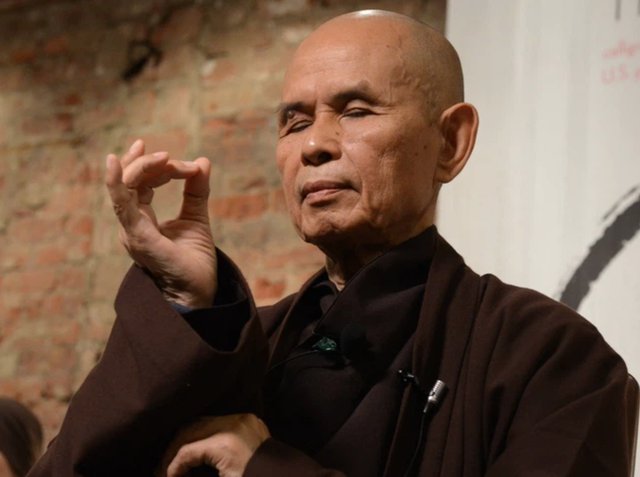
In his brown Buddhist robes the Venerable Thich Nhat Hanh is a
slight figure who seems, but for the suffering in his eyes, to be barely
out of his adolescence. In fact he is forty-four years old, a monk
since he joined a Zen community at the age of sixteen, the author of ten
books, including three acclaimed volumes of poetry. Since 1966 Thich
Nhat Hanh has been in exile from his native South Vietnam, unable to
return because of his outspoken opposition to the war and to the
military rulers in Saigon. He is the observer of the Unified Buddhist
Church of Vietnam at the Paris negotiations. A few weeks ago he visited
Washington—perhaps his last such visit, since Saigon has announced it is
revoking his passport—and offered these three steps that the United
States can take to end the war in Vietnam:
“One—to declare unilaterally an immediate cease-fire, stopping
all aerial bombing and ground missions and the use of chemical
defoliants, and withdrawing to positions of self-defense. This action
will not only stop the destruction of human life but will also clearly
prove the American intention to end the war. It will draw considerable
sympathy and support within and without Vietnam. It will encourage
Vietnamese on both sides to stop shooting at each other.
“Two—to pledge complete withdrawal of all U.S. military forces
from Vietnam and to announce a timetable for such withdrawal. This
action will assure Vietnamese who support the National Liberation Front
that foreign soldiers are not going to be in the country any more, and
there is no reason to support a war that kills only Vietnamese. It will
also allow Vietnamese on both sides to come together to seek a political
settlement.
“Three—to stop supporting the present Saigon government in its
attempt to impose itself longer on the Vietnamese people. This action
will lead to the end of corruption and dictatorship in Saigon, to the
release of political prisoners, to the restoration of religious and
civil liberties, and to the formation of a peace government that can get
the overwhelming support of the Vietnamese people.”
The most urgent of these steps, the indispensable step, is a
ceasefire, Thich Nhat Hanh insisted. In a voice barely audible, he said:
“The Vietnamese people are so tired of war. Vietnamization is just an
attempt to continue the war with fewer American troops but more American
arms. What we need most, what we need now, is an ending of the
killing.”
In a June 1977 article entitled “On Rage Remembered,” Ann Morrissett
Davidon of the War Resisters League wrote: “But then sometimes there are
dramatic images—even if conveyed by the television screen, as in the
1960s—which remind us of the human meaning and historical scope of the
struggle. Adrenalin mounts, hearts beat faster, rage rises against those
insidious systems which let some men rise on the backs and bodies of
other people while so often claiming to help them. . . . The men who
happen to be in control will not like it, may not even know quite what
they’re doing, but they need to know that we struggle not against them
personally, but against the systems of profit and power by which they
exploit human beings and the earth’s resources. As the Vietnamese
poet-priest Thich Nhat Hanh wrote in the midst of that cruelly
protracted and embittering war:
Men cannot be our enemies.
Not even men called “Viet Cong.”
If we kill men,
What brothers have we left,
With whom shall we live then?
And most recently, in September 2009, in a review of the book Fire and Ink: An Anthology of Social Action Writing.
Then-editor Matthew Rothschild noted: “You’ll find a lot of inspiration
and wisdom here. One essay by Thich Nhat Hanh cautions us that raising
our voice is not enough: ‘To educate people for peace, we can use words
or we can speak with our lives.’ ”
In a time when the drumbeat for war seems loud in the air, we remember the lessons of this engaged Buddhist monk.
More from The Progressive